


Learned Helplessness in Teams: When a Leader’s Victim Story Infects the Whole Room

Learned helplessness in teams begins when the leader models powerlessness — and once the team imitates it, accountability, courage, and momentum start to decay.
Last Updated: June 18, 2026
TL;DR (Quick Summary)
Teams watch leaders closely and often model what the leader rewards, avoids, tolerates, or performs.
A leader’s learned helplessness can create group helplessness, excuse-making, blame cycles, and stalled execution.
Machiavellian or narcissistic team members may read a helpless leader as an opening to seize informal power.
The Greek myth of Jason and Medea show how a leader’s helplessness can give a monstrous high performer the opening to take over the mission.
How a leader can right the ship: call out the Victim Story that they and the Team have been playing, restore accountability, and rewrite the Hero Story for the team.

Learned Helplessness in Teams Starts With the Leader Everyone Is Watching
Does your team keep missing goals because impossible circumstances seem to always keep them from moving forward?
If so, is the real issue that goals are impossible to meet ... or that they've learned accountability is impossible for you to enforce?
That question might sting. If so, all I can say is: "Good."
Some questions need to sting.
In my most recent blog post, HERE, we discussed the concept of "learned helplessness" in leadership. Learned helplessness occurs when leaders begin believing they have no real ability to control their circumstances or their team members. They repeatedly experience obstacles as uncontrollable and eventually stop acting as if their choices matter.
In the Myth Slayer framework, learned helplessness has its origins in the internal narratives the leader tells him or herself about who they are and where their career or team is going. The "Victim" is one of 5 toxic roles people play inside these internal narratives (or "myths.")
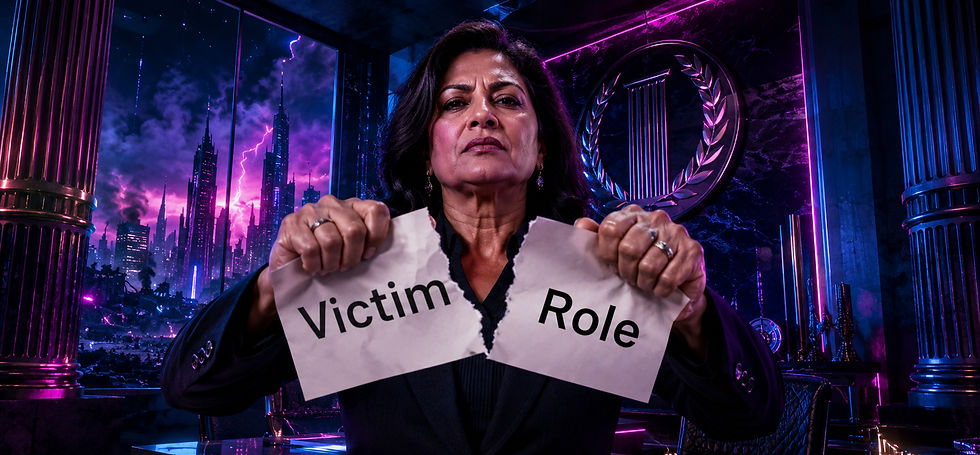
A Victim role allows a leader to avoid internal accountability for their team or organization's failures. It can preserve your ego, but it also makes you blame, freeze, and sacrifice your own power ... and the whole team sees it.
In organizational settings, whether tiny or large, learned helplessness is a pattern that can spread like a virus through meetings, language, norms, and modeled behavior. And once it starts, everything from project success to individual, day-to-day task performance -- even adherence to basic ethical standards -- can fall apart.

The Victim Story Becomes Your Team's Playbook
In the Myth Slayer framework, the Victim is one of the toxic roles people play inside larger internal narratives that are, from a professional growth/personal empowerment perspective, highly damaging ("toxic myths").
As the image above describes, the Victim is defined by powerlessness, unappreciated sacrifice, and lost chances to become their business or organization's Hero: the driver of their or their team's narrative (and outcomes), rather than a passive passenger.
Now take that role and put it in charge of a team. Unsurprisingly, the result is almost universally disastrous.
A leader caught in learned helplessness sends a subconscious message:
⚡️ “Bad things are always happening to us.” (vs., in example, "for" or "because of" us)
⚡️ “We cannot control the situation.”
⚡️ “No one can be held responsible because everything is too hard.”
Once that messaging takes root in a team, project meetings become complaint rituals. Accountability slides off the table. People begin protecting themselves from blame instead of moving the work. The ambitious ones become frustrated and leave. The political ones start calculating.
Soon Amechania has entered the room.
As discussed in the last blog post, Amechania the Greek spirit of helplessness and want, accompanied by Penia (Poverty) and Ptocheia (Beggary). The symbolism is a perfect metaphor for the impact of learned helplessness on a team. A helpless team cannot produce, inevitably leading to financial distress (poverty). Financial distress brings desperation. Desperation brings dependence (beggary), specifically on whomever promises a way out.
That is where the scourge of poor-performing teams, the high-performing nightmare, is born.

The High-Performing Nightmare
A high-performing nightmare (aka the toxic superstar) is the team member who delivers outstanding results on paper, but whose behavior -- both to other team members and, often, to outside stakeholders -- damages ethics, culture, trust, morale, and, most critically, the leader’s own credibility.
I speak on this problem often because it is one of the most dangerous traps in modern leadership. My session on toxic superstars has been presented across legal education platforms, SHRM chapters, association events, within major organizations, and in a variety of other leadership settings.
This presentation can have a real, practical impact on a leader's career and a team/organization's trajectory when everyone knows that a single person is damaging the culture ... but no one wants to speak the truth about it out loud.
The problem created by a high-performing nightmare is simple enough to describe:
⚡️ Someone gets results that look good on paper.
⚡️ Every person who interacts with them knows they create endless drama.
⚡️ The leader feels helpless because the person seems too useful to confront.
⚡️ That hesitation becomes permission.
⚡️ The monster that the toxic superstar becomes is the monster the permission created.
In other words, the leader’s learned helplessness becomes the team's stairway to Hades.

Jason, Medea, and the Golden Fleece
Greek mythology gives us the perfect allegory -- and case study -- for this dreadful process.
In the myth, Jason was the leader of a large team working together on an unusually challenging project: retrieval the Golden Fleece. The Golden Fleece was the ancient Greek equivalent of a hoodie, made from wool of solid gold. To get it, Jason had to face terrifying challenges, including a dragon guarding the Fleece.
Medea was a brilliant sorceress who fell in love with Jason. She had power Jason did not have. To help Jason get the Fleece, Medea became, for all intents and purposes, his right hand. Using a variety of tactics that were both underhanded and cruel, Medea helped Jason achieve the only metric that he cared about: getting the Golden Fleece away from the dragon and into his hands.
In the name of Jason's mission and the success of the team, Medea used witchcraft to create deadly poisons, betrayed her family, and even killed her own brother. in the process, Medea became one of the most terrifying figures in Greek myth and the most dramatic example ever of a high-performing nightmare.
The leadership lesson:
Jason needed the Fleece. He faced a dragon. He felt helpless. Jason's self-imposed helplessness created an opening for Medea’s power -- and her monstrous actions.
Today, a leader who feels helpless in front of the dragon may hand the mission to whomever promises victory. Like Medea, that person may deliver. That person may also become monstrous.
This is exactly how leaders get trapped by toxic superstars. The leader thinks, “ I have no choice. I need them.” The team thinks, “Our boss is helpless.” The high-performing nightmare thinks, “I am the real power here.”
That is how a leader's learned helplessness hijacks the team -- and the mission.
By the way, thanks to Medea, Jason ended up losing all of his credibility as a leader. Eventually, everyone who mattered in his life abandoned him and he died alone, rejected and penniless. The leadership lesson from that portion of the story needs no explanation at all.

When Team Members Imitate Helplessness
If a leader's learned helplessness doesn't create a toxic superstar, a second danger can still emerge -- one that is less dramatic, but just as costly.
The danger: that the team imitates the helpless leader.
Social cognitive theory holds that people can learn by observing others, including by watching behavior and its consequences. Application of social cognitive theory to organizational management emphasizes that cognitive, social, and behavioral competencies can develop through modeling processes in organizational settings, including the observation and adoption of modeled strategies. See: Wood, R., & Bandura, A. (1989), "Social Cognitive Theory of Organizational Management," Academy of Management Review, 14(3), 361-384.
In plain English, your team is studying what your behavior permits: who you blame, what you avoid, and the story you've created about who they are and how they operate within the team.
More specifically, they are always watching whether accountability survives contact with pressure.
So when a leader lives in a Victim Story, the team may begin to mirror that story. you'll start to hear things like:
⚡️"The market is impossible."
⚡️"The government is making things impossible."
⚡️"The client is impossible.
⚡️ "The company's top leadership doesn't know what they're talking about."
And on and on and on.
Some of those claims may contain facts. No reasonable person would deny that.
However, a helpless team sees obstacles as endings -- versus a team rooted in Heroism. Those teams see obstacles as their very reason for existing.
When learned helplessness takes over a team or an organization, morale suffers because no one believes effort will change the outcome. Financial performance suffers because hard choices keep sliding into the future. Reputation suffers because excuses become visible to clients, funders, customers, boards, partners, and stakeholders. Market position suffers because competitors keep moving while your team keeps blathering on about why movement cannot happen.
Yet again, Penia and Ptocheia follow Amechania. Helplessness attracts poverty of action. Beggary shows up when the team starts begging circumstances to improve instead of exerting their creativity and will over the things they can control.

KPIs Cannot Save You
A KPI-only culture often makes this worse.
In such an environment, leaders relentlessly track outputs, dashboards, timelines, utilization, revenue, client satisfaction, engagement, and productivity. make no mistake: those numbers matter. But they do not measure what role the leader is playing in the team’s story -- the role that, ironically, all of the other metrics depend on.
My entire mission exists for leaders who have outgrown performance without meaning. The core work is helping accomplished leaders name the internal toxic myth shaping their decisions and consciously rewrite the identity they will lead from next.
A leader who keeps acting helpless will eventually build helplessness into every facet of their team's operations. On the other hand, a leader who names the Victim role can begin clearing it from the team’s narrative -- opening the door to broader staff thinking, more openness to creativity, greater willingness to weave their way through and around obstacles, deeper and more sustainable engagement, and fearlessness when staring at dragons.
Imagine organizations led by people who lived from, and built entire teams grounded in, that place.
⚡️ Less whining about "why we can't."
⚡️ No more toxic superstars protected because they “get results.”
⚡️ Fewer teams begging for rescue from conditions they actually have the power to change.
Who wouldn't want to be the leader who faces the dragon, names the myth, and leads the army to action?

Coaching Step: Audit the Room
In your next team meeting, listen for helplessness. Don't announce it as a grand exercise. Just listen.
Write down the exact phrases people use when the room starts surrendering agency. Examples may include:
⚡️“There’s nothing we can do.”
⚡️“That department always blocks us.”
⚡️ “This client always does XYZ.”
⚡️ “The Big Bosses don’t care.”
⚡️ “The regulations make this too hard.”
Some of those statements may contain facts. So what? Your job isn't to gripe about the dragon, but to somehow get the Golden Fleece. So before the meeting ends, ask:
“What decision can we make today that would reduce the damage, move the work, or restore one piece of control?”
Then make the decision -- and demand action.
That will stop Amechania at the door.
And If your organization is struggling with a high-performing nightmare, or a team that has turned helplessness into culture, bring me in to speak or facilitate a session.
I help legal, HR, association, nonprofit, government, and executive audiences name the toxic myths underneath leadership paralysis, confront the roles people are playing, and write a Hero Story strong enough to move the room.
If any of this is happening in your organization, DM me or book a call here:
We'll talk about what is really going on — and what kind of session can help your people face it. Because ...
I want your future to be EPIC!

Quick answers (FAQ)
Q1: What’s the core leadership lesson?
A leader’s Victim Story does not stay private. Teams study the leader’s behavior and learn what kind of story defines the team or organization, and where that will take them.
Q2: What can I do in the next 24 hours?
Audit your next meeting. Count how many times the conversation moves into blame, helplessness, vague obstacles, or “nothing we can do.” Then name one decision the team can make before the meeting ends.
Q3: How does this tie to mythic leadership?
Mythic leadership means seeing the story underneath the behavior. Once you name the toxic myth and the toxic role being performed, the team can stop reenacting helplessness and start operating from a Hero Story.

I'm Scott Mason, The Myth Slayer. I am an attorney and former C-Suite executive, coach, speaker, podcaster, and Master of the Mythic. I graduated from Columbia Law School and have spent years drawing on the full depth of a background spanning the private, public, and nonprofit sectors to provide lawyers feeling stuck or stagnant in their careers or as leaders with a unique (and fun!) system to help them live a life that's epic.
Click here to discover more about me, my mission, and how it can help you.
If you've ever said, "I'm capable of more -- and I want it?" ... then download my five-minute self-assessment, and I'll show you how to experience professional rebirth, increase your inspiration, and create a bold impact NOW!
NO AI TRAINING: Without in any way limiting the author’s, blogger’s and/or publisher’s exclusive rights under copyright, any use of this publication to “train” generative artificial intelligence (AI) technologies to generate text is expressly prohibited. The author/blogger/publisher reserves all rights to license uses of this work for generative AI training and development of machine learning language models.
Comments